 English
 Spanish
 French
 German
 Italian
 Amharic
 Afrikaans
 Arabic
 Chinese
 Japanese
 Korean
 Turkish
 Finnish
 Bengali
 Czech
Czech
 Indonesian
 Danish
 Greek
Greek
 Hindi
Hindi
 Armenian
 Malay
Malay
 Dutch
Dutch
 Norwegian
 Polish
 Portuguese
 Romanian
 Russian
 Swedish
 Thai
Thai
 Vietnamese
 Ukrainian
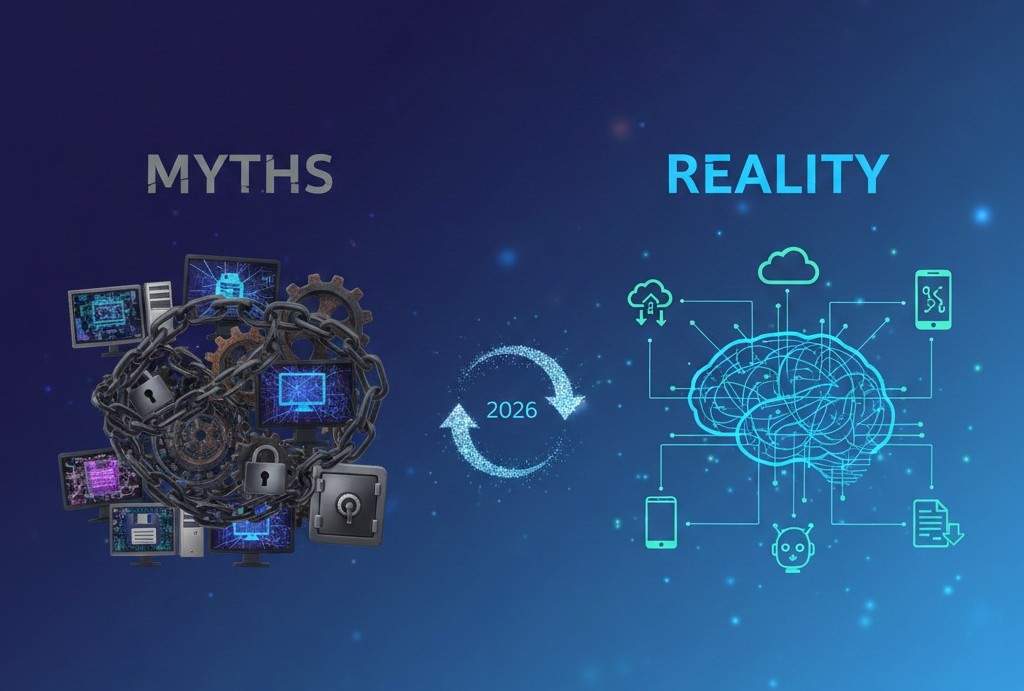
PDF Myths vs Reality in 2026: What Most People Still Get Wrong
Why PDF Myths Still Exist in 2026
PDFs have been around for decades, yet many people still believe outdated ideas about how they work. These misconceptions lead to wasted time, unnecessary software costs, and inefficient workflows.
In 2026, online PDF tools have completely changed what's possible—but myths continue to slow users down.
This article separates PDF myths from reality, helping you understand what's true, what's outdated, and how to handle PDFs the smart way today.
Myth #1: PDFs Are Hard to Edit
Reality
PDFs are not hard to edit you're just using the wrong approach.
Trying to edit a PDF directly often causes frustration. The smarter method is converting it into an editable format first.
Once converted, editing becomes as easy as working in a Word document.
Myth #2: You Need Paid Software to Work With PDFs
Reality
Most everyday PDF tasks don't require paid software.
Free online PDF tools can:
- Convert files
- Compress large PDFs
- Merge documents
- Handle images
- Summarize content with AI
All without installation, subscriptions, or watermarks.
Myth #3: Online PDF Tools Are Not Secure
Reality
Security depends on the platform—not the tool type.
Trusted online PDF tools use:
- HTTPS encryption
- Automatic file deletion
- No file storage
- No account requirements
In many cases, this is safer than storing files locally on shared or unsecured devices.
Myth #4: Large PDF Files Can't Be Reduced Without Quality Loss
Reality
Modern compression tools reduce file size intelligently.
Compression optimizes internal structures without noticeably affecting visual quality—perfect for sharing and uploading.
Myth #5: PDFs Are Not Mobile-Friendly
Reality
PDFs are one of the most mobile-compatible formats available.
With browser-based tools, users can:
- Convert
- Compress
- Merge
- Share PDFs
directly from smartphones and tablets no apps required.
Myth #6: Images Are Better Than PDFs for Sharing Documents
Reality
Images lack structure, consistency, and professionalism.
A better approach is converting images into PDFs.
PDFs are easier to organize, store, and share especially for documents.
Myth #7: PDFs Take Too Long to Read
Reality
AI has changed how we consume documents.
Instead of reading entire PDFs , users can summarize them instantly:
This saves time and improves understanding.
Why These Myths Hurt Productivity
Believing these myths leads to:
- Extra software costs
- Manual work
- File errors
- Delayed communication
- Frustration
Correcting them creates faster, smoother workflows.
How Modern PDF Tools Changed the Reality
Today's online PDF tools are:
- Faster
- Smarter
- AI-powered
- Device-agnostic
- Free and accessible
They are built for real-world workflows, not outdated assumptions.
External Perspective
According to MIT Sloan Management Review , removing misconceptions about digital tools improves adoption and efficiency. This directly applies to modern PDF workflows.
Conclusion: Stop Believing the Myths
PDFs are not complicated, slow, or outdated. Most frustrations come from old habits and misinformation, not from the format itself.
By understanding the reality of modern PDF tools, users can work faster, save money, and eliminate unnecessary friction. PDFtools.net provides everything needed to handle PDFs efficiently in 2026—without myths, software, or limits.
Discover the smarter way to work with PDFs: https://www.pdftools.net
FAQs
1. Are PDFs outdated in 2026?
No. PDFs remain one of the most reliable and universal formats.
2. Can free PDF tools replace paid software?
For most users, yes. Paid tools are only needed for advanced enterprise workflows.
3. Are online PDF tools accurate?
Trusted platforms maintain formatting and quality consistently.
4. Can PDFs be managed entirely on mobile?
Yes. Browser-based tools work smoothly on mobile devices.
5. Is AI really useful for PDFs?
Yes. AI summarization significantly reduces reading time.