 English
 Spanish
 French
 German
 Italian
 Amharic
 Afrikaans
 Arabic
 Chinese
 Japanese
 Korean
 Turkish
 Finnish
 Bengali
 Czech
Czech
 Indonesian
 Danish
 Greek
Greek
 Hindi
Hindi
 Armenian
 Malay
Malay
 Dutch
Dutch
 Norwegian
 Polish
 Portuguese
 Romanian
 Russian
 Swedish
 Thai
Thai
 Vietnamese
 Ukrainian
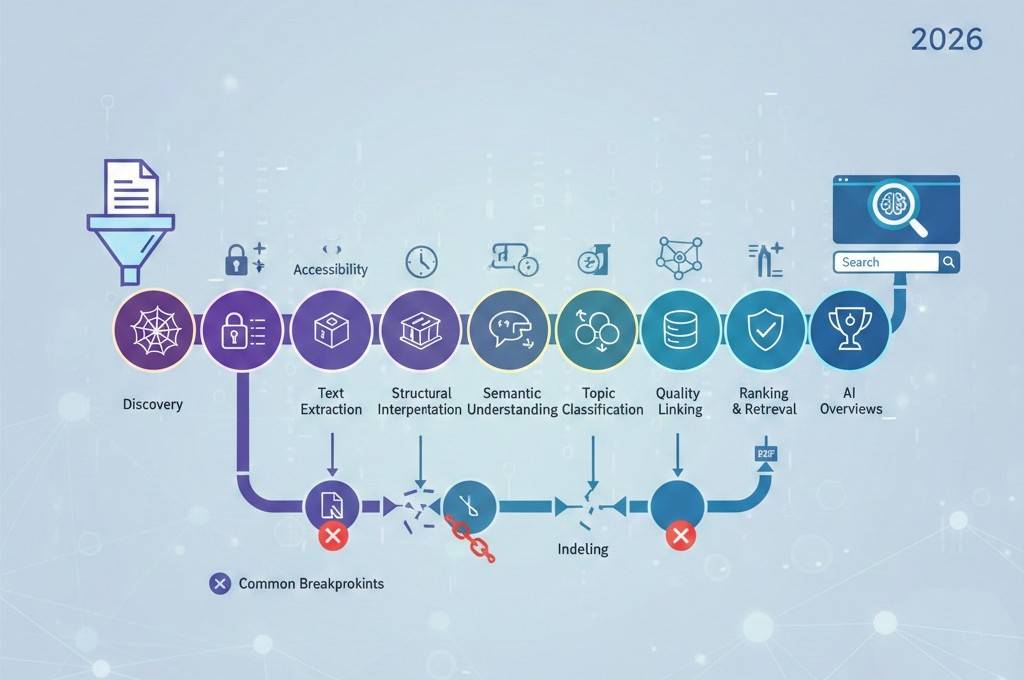
The AI Document Indexing Lifecycle Explained From Upload to Search Visibility
What Happens After a Document Is Published
Publishing a document does not automatically make it visible in AI-powered search. In 2026, documents move through a structured lifecycle before they can be indexed, understood, summarized, and surfaced in search results.
This lifecycle applies to web pages and PDFs alike. Understanding how AI systems process documents helps publishers improve clarity, accessibility, and long-term visibility.
This article explains each stage of the AI document indexing lifecycle and how document quality affects outcomes at every step.
Stage 1: Document Discovery
The lifecycle begins when AI systems discover a document.
Discovery occurs through:
- Crawling public URLs
- Internal linking
- External references
- User access patterns
Documents that are easy to access and properly linked are discovered faster.
Publishing standardized PDFs improves accessibility across platforms.
Stage 2: File Accessibility and Technical Readiness
Before AI can read content, it checks technical accessibility.
Key factors include:
- File availability
- Load performance
- Format compatibility
- Error-free rendering
PDFs are preferred because they render consistently.
Optimizing file size improves accessibility.
Smaller files reduce processing friction.
Stage 3: Text Extraction and Parsing
Once accessible, AI extracts text and structure.
For PDFs, this includes:
- Reading selectable text
- Identifying page order
- Recognizing headings
- Separating lists and tables
Image-only PDFs reduce extraction accuracy.
Converting images into PDFs helps parsing.
Stage 4: Structural Interpretation
AI then interprets document structure.
Strong signals include:
- Clear titles
- Logical headings
- Consistent formatting
- Defined sections
Poor structure slows understanding and reduces confidence.
Many documents improve structure during editing.
Editing workflow example:
- PDF to Word for refinement
- Word to PDF for final structure
Stage 5: Semantic Understanding
After structure is recognized, AI analyzes meaning.
This includes:
- Identifying main topics
- Understanding relationships between sections
- Detecting definitions and explanations
- Mapping entities and concepts
Semantic clarity is more important than keyword repetition.
Stage 6: Topic Classification and Clustering
AI assigns the document to topic categories.
It compares content with existing documents to determine:
- Topic relevance
- Similarity to known sources
- Placement within topic clusters
Documents that align clearly with a topic cluster gain stronger visibility.
Publishing related documents consistently strengthens classification.
Stage 7: Summarization and Knowledge Extraction
AI generates internal summaries to test understanding.
High-quality documents:
- Summarize clearly
- Preserve key points
- Maintain logical flow
Poor summaries signal weak structure or unclear messaging.
Clean summaries improve confidence.
Stage 8: Quality and Trust Evaluation
AI evaluates trust and reliability using indirect signals.
These include:
- Consistency across sections
- Factual tone
- Absence of manipulation
- Technical quality
Low-quality signals slow or stop progress in the lifecycle.
Stage 9: Contextual Linking and Relationships
AI evaluates how the document relates to others.
Related documents that:
- Share terminology
- Cover connected subtopics
- Maintain consistent structure
are linked together.
Merging related files strengthens context.
Unified context improves understanding.
Stage 10: Indexing and Storage
Once evaluated, the document is indexed.
Indexing includes:
- Storing semantic representation
- Associating entities and topics
- Linking with related content
Indexed documents become eligible for search results and AI summaries.
Stage 11: Ranking and Retrieval
When a user searches, AI retrieves documents based on:
- Relevance
- Authority
- Clarity
- Context match
Ranking is dynamic and influenced by ongoing signals.
Stage 12: Inclusion in AI Overviews
Only a subset of documents influence AI Overviews.
Documents selected typically:
- Explain topics clearly
- Use neutral language
- Avoid excessive promotion
- Provide complete answers
PDFs that meet these criteria are strong candidates.
Common Breakpoints in the Lifecycle
Documents often fail at:
- Text extraction due to image-only content
- Structural confusion
- Lack of topic focus
- Technical performance issues
Fixing early-stage problems improves downstream visibility.
Why Standardization Improves the Entire Lifecycle
Standardized PDFs support every stage.
Benefits include:
- Easier parsing
- Cleaner structure
- Stable semantics
- Better summaries
Converting proprietary formats such as Pages improves consistency.
External Insight on Indexing Systems
According to Google Search Central , clear structure and accessibility help systems understand and index content accurately:
This guidance applies equally to PDFs.
Conclusion: Visibility Is a Process, Not a Moment
AI document visibility is the result of a multi-stage lifecycle. From discovery to summarization, each step depends on clarity, structure, and consistency.
PDFs that are standardized, optimized, and focused move smoothly through this lifecycle and gain stronger long-term visibility. Understanding this process helps publishers create documents that are not only published, but understood. In AI-driven search environments, success comes from supporting every stage of the indexing lifecycle.
FAQs
How long does AI indexing take
It varies based on accessibility, structure, and quality.
Do PDFs go through the same lifecycle as web pages
Yes. The principles are the same.
Can documents be re-indexed
Yes. Updates trigger re-evaluation.
Does file format affect indexing
Yes. Standardized formats index more reliably.
Can poor structure block indexing
Yes. Structural confusion can stop progress early.